Finding the right estate for Project Argyll requires more than assembling a list of beautiful places. Each candidate must be examined consistently, with enough structure to expose weaknesses, compare trade-offs, and prevent one memorable feature from overwhelming everything else that will determine whether the site can work.
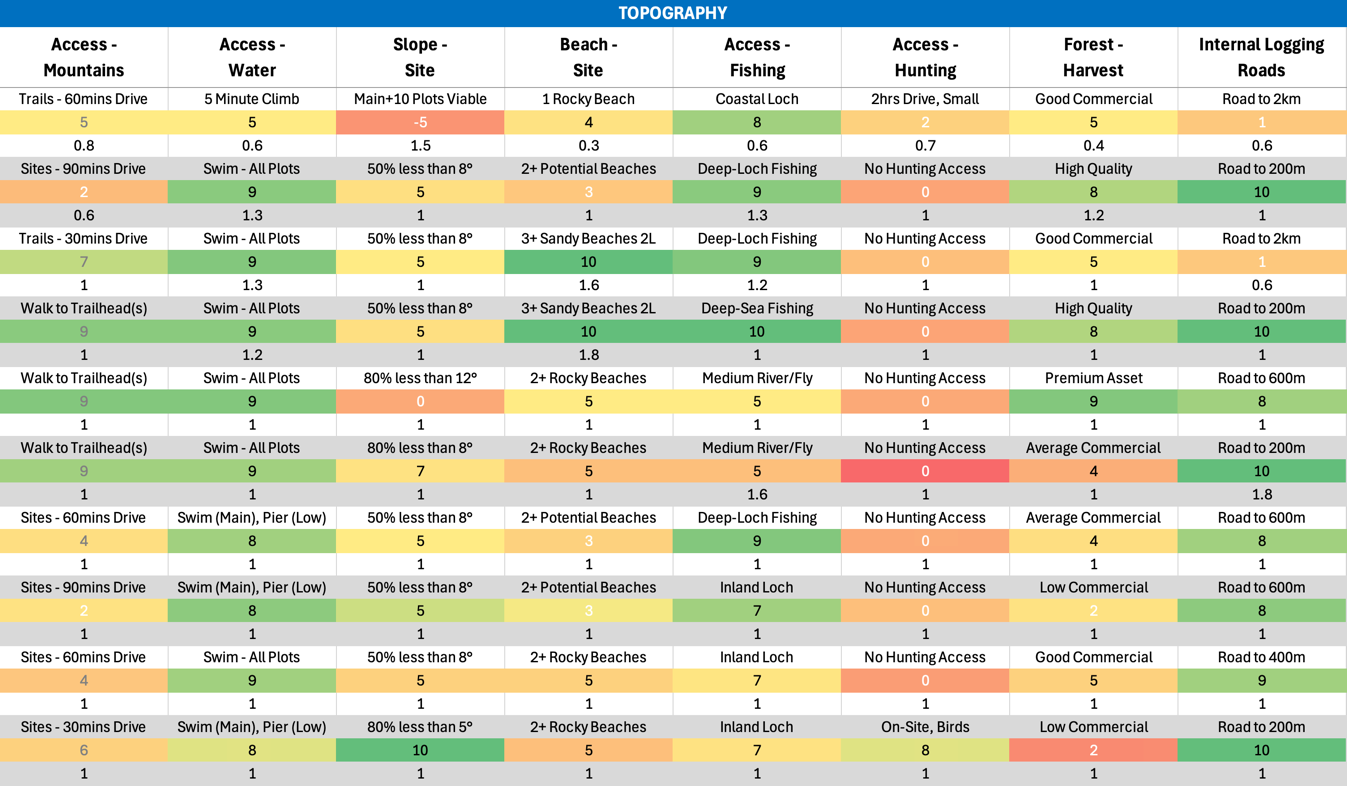
Our assessment table translates the project brief into a detailed set of comparable criteria. It records matters such as access to mountains and water, usable slopes, waterfront characteristics, forestry, existing roads, buildings, utilities, development potential, travel times, and the practical relationship between personal plots and shared land. The coloured scores make patterns visible quickly, while the notes beneath them preserve the evidence behind each judgement.
Not every criterion carries the same importance. A feature that is attractive but optional should not compensate for a fundamental problem with access, planning, water, or developable ground. The working model therefore allows important factors to carry greater weight and serious constraints to reduce a site’s overall standing. This helps distinguish between an estate that photographs well and one capable of supporting the project over decades.
Scoring does not replace judgement. Some qualities are difficult to reduce to a number, including the feeling of arrival, the relationship with neighbouring communities, the coherence of the landscape, and whether existing buildings offer genuine possibilities. The table creates discipline around discussion, but site visits, professional advice, and careful interpretation remain essential.
The process is also iterative. Initial particulars may suggest one conclusion, a visit another, and later information from surveyors, planners, forestry specialists, or solicitors a third. Scores and notes must change when better evidence appears. A candidate can improve as uncertainty is resolved, or fall away when a hidden cost, legal restriction, environmental duty, or infrastructure problem becomes clear.
This rigour is valuable precisely because the final decision will be consequential. Land selection will shape the project’s finances, planning strategy, maintenance responsibilities, construction options, and daily experience for generations. A transparent assessment process gives founders, advisers, and future members a common basis for asking questions and challenging assumptions. It does not guarantee a perfect estate, but it makes it far less likely that Project Argyll will choose the wrong one for the wrong reasons.