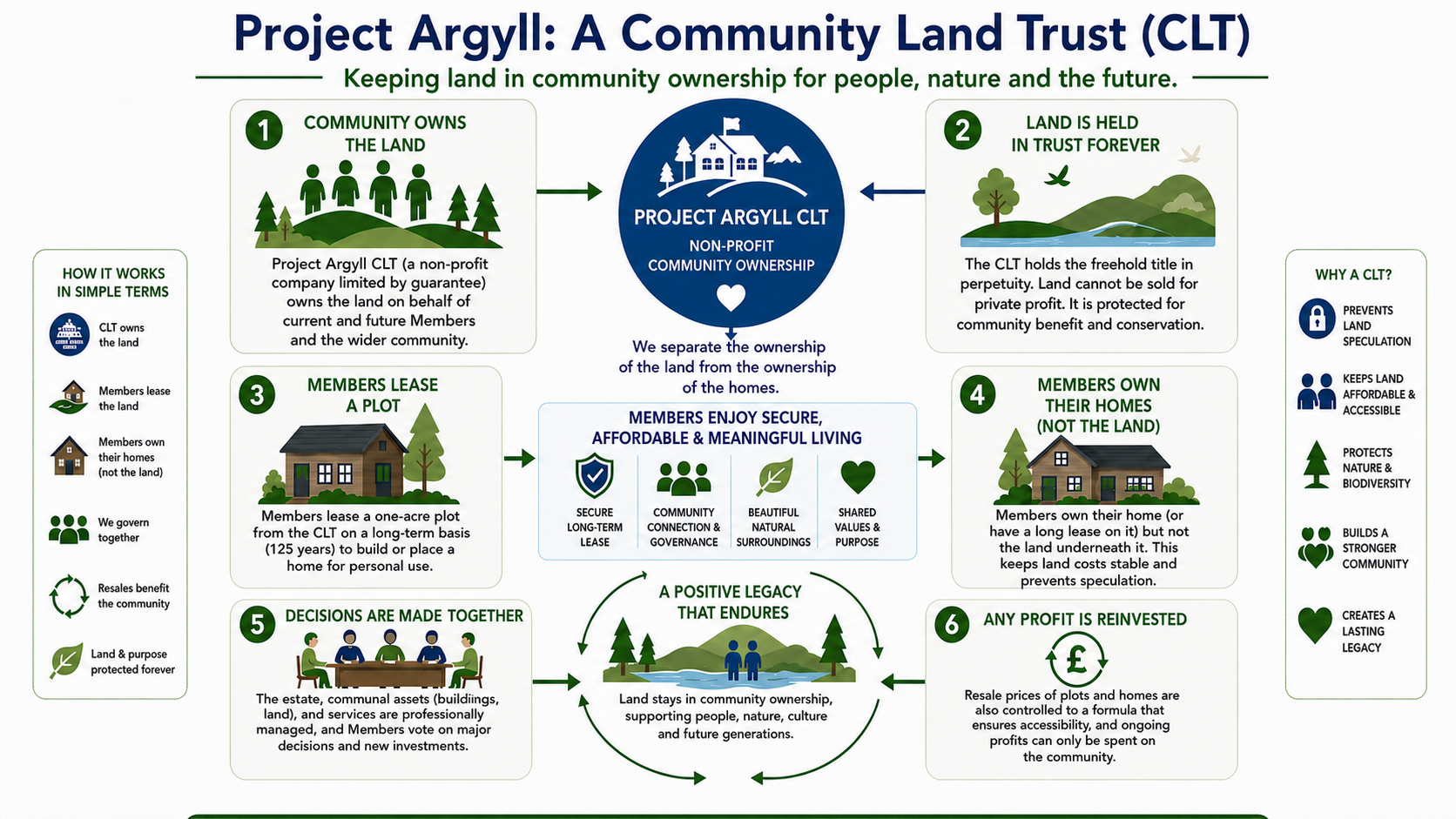
A community land trust is not a style of housing, nor one legal form. It is a long-term stewardship model. A not-for-profit organisation owns land for a defined purpose, members participate in governance, and any surplus is retained rather than distributed as private profit. The land remains intact while people receive secure rights to use and improve particular parts of it.
Project Argyll is applying those principles through a Scottish company limited by guarantee. The company is intended to hold the estate, while members receive defined long-term rights to plots, homes, and shared facilities. Members will vote on major decisions, communal assets will be professionally managed, and resale arrangements are intended to protect accessibility and discourage speculation. Detailed leases, governance rules, and safeguards remain subject to specialist advice before commitments are made.
This is an established family of models, not an untested invention. Community land trusts operate internationally, and the Community Land Trust Network records hundreds across England and Wales. Scotland has its own strong tradition of community landownership. The Stornoway Trust dates from 1923, and Community Land Scotland reports that more than 500 Scottish communities now own land or buildings. The Scottish Government supports qualifying geographic communities through statutory rights and the Scottish Land Fund.
Project Argyll should not be confused with those statutory routes. Many Scottish community ownership bodies represent everyone living within a defined area. Project Argyll is a member-based initiative purchasing land on the open market. Its legal form, membership, and eligibility for public programmes must be assessed on their own terms. What it shares with the wider movement is democratic governance, durable stewardship, and land managed beyond a short investment cycle.
For members, the structure is intended to combine personal security with collective scale. Each household can shape a private place, while woodland, water, access, cabins, services, and infrastructure remain part of one coherent estate. Keeping the freehold together can clarify long-term maintenance, prevent fragmentation, and give members a direct vote on decisions affecting shared costs and the landscape.
The surrounding region should benefit as well, but that is not automatic. It depends on how the organisation procures services, manages land, and works with neighbours. Responsible stewardship can support local contractors, environmental restoration, skills, access, and partnerships. A community land trust framework can preserve those benefits over time. Good governance and sustained local relationships are what will turn that capacity into a positive legacy.