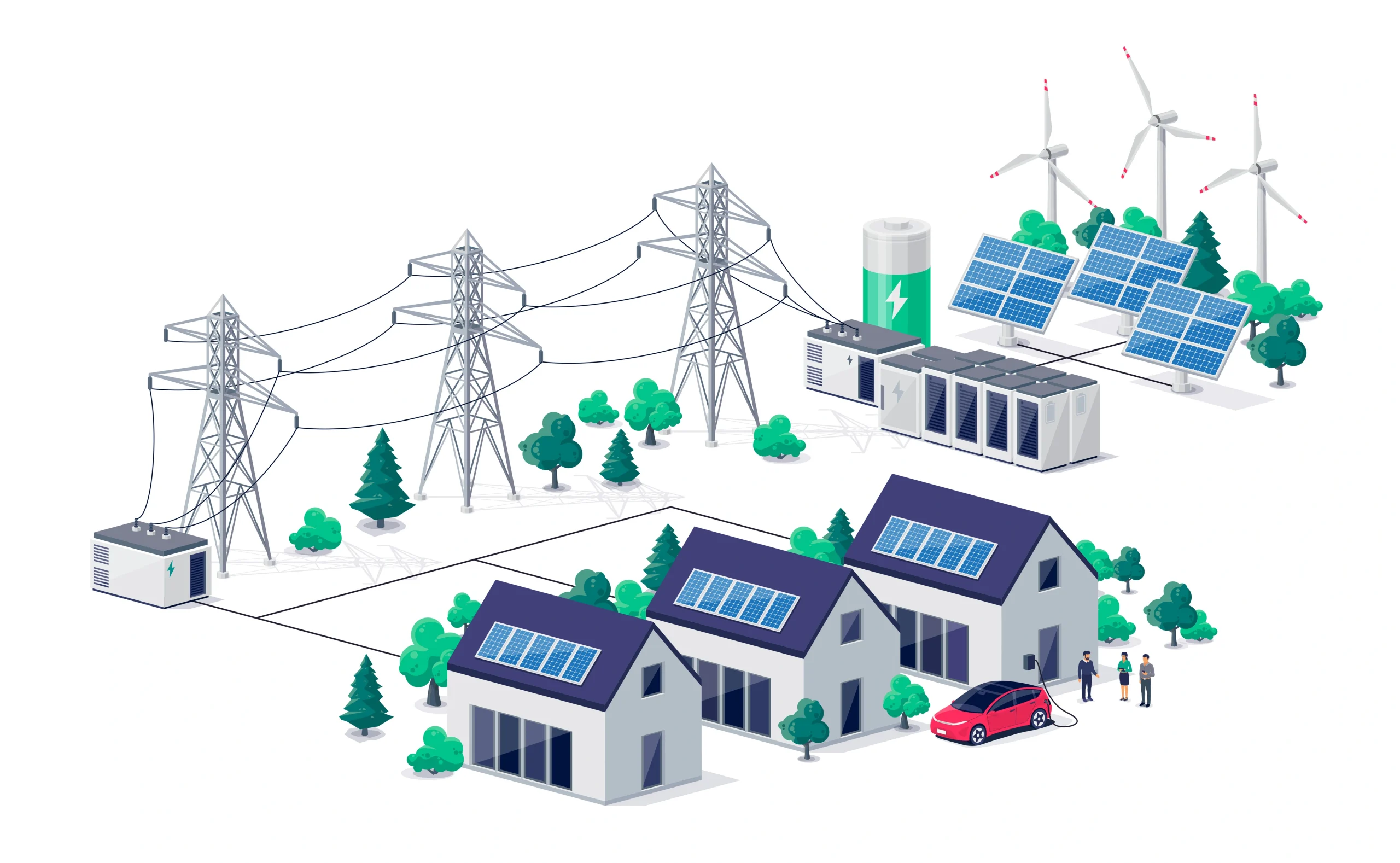
Project Argyll aims to create a Virtual Power Plant at the core of the estate. A Virtual Power Plant is not one large generator. It is a coordinated network of smaller energy resources that can behave as one system. Generation, storage, and flexible demand are managed together, helping to balance supply and use across buildings while retaining a connection to the wider electricity network.
The shared core would contain more capacity than its own buildings require. Subject to the estate and professional design, that could combine load management, substantial battery storage, solar generation, micro-hydro where water conditions permit, community wind, and heat pumps. Smart controls would decide when to use electricity directly, store it, redirect it across the estate, import it, or potentially export it. A west-coast Scottish estate case study already combines hydro with an intelligent power hub and batteries to serve several buildings.
Each member’s home would form part of the same architecture. Homes would be required to install compatible solar panels, battery storage, and heat pumps, with controls able to exchange power and flexibility with the shared system. Electric-vehicle charging would also be designed for vehicle-to-grid operation. Compatible cars and bidirectional chargers can treat parked vehicle batteries as additional storage, although equipment choices and network approval will determine what is possible.
The value comes from diversity. Solar produces during daylight, Highland wind may be strongest at different times, and a suitable watercourse can provide steadier generation. Batteries can shift surplus power into periods of higher demand. Heat pumps, hot-water storage, vehicle charging, and other flexible loads can be scheduled around availability. Wind can complement solar production, while batteries make surplus generation available later.
For members, the intended result is lower dependence on imported electricity, better use of locally generated power, and greater resilience when individual sources underperform. For the project, shared controls and larger core storage could avoid every household having to solve balancing alone. Community Energy Scotland’s work demonstrates that community-led renewables can combine practical decarbonisation with local capability and long-term benefit.
This remains a design objective rather than a confirmed specification. Its scale, economics, ownership, tariffs, metering, data governance, maintenance, and allocation of benefits will require transparent rules. The final system will depend on energy surveys, planning, natural resources, grid capacity, distribution-network approval, safety standards, and specialist engineering. Those constraints should shape the design early, not be treated as details after the estate is chosen.