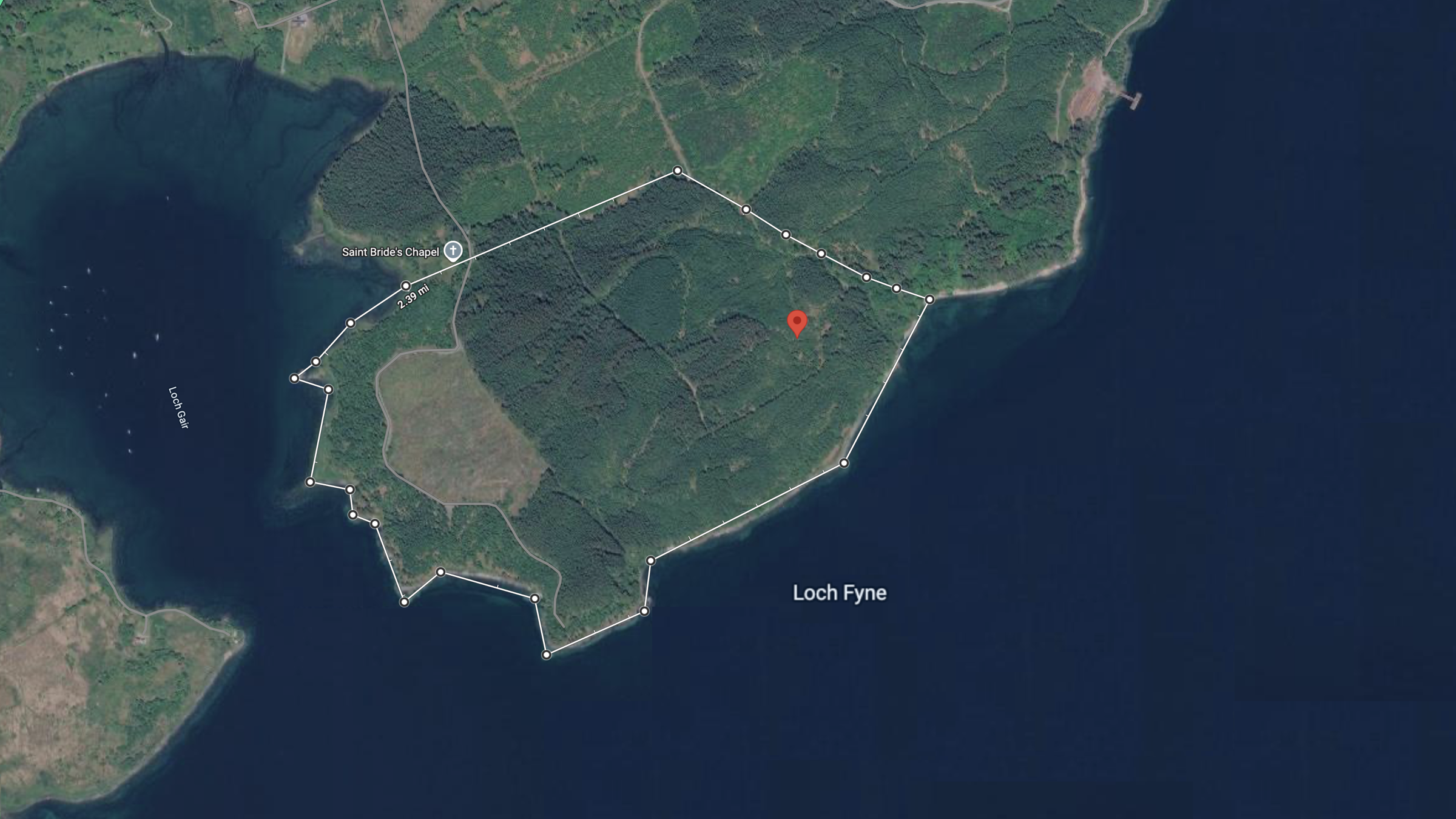
Ardcastle Wood is Site 14 in our working assessment: approximately 200 acres of coastal woodland on a peninsula beside Loch Fyne. At the time of review, the working price was £1.2 million, or roughly £6,000 per acre. It remains in review. This profile is not an endorsement or a statement of purchase intent, but an example of how we test an attractive location against the full Project Argyll brief.
The immediate strengths are scale, shape, and water. The recorded boundary includes a long and varied shoreline, two or more potential beaches, swimming access, possible low-level pier access, and deep-loch fishing. Around 80 per cent of the site is recorded as having a gradient below 12 degrees. That combination of relatively gentle land, woodland, and waterfront could provide meaningful separation between private plots while preserving a much larger shared landscape.
The existing physical structure may also help. The assessment records extensive internal logging roads, public-road access approximately 200 metres away, small-scale forestry activity, and grid electricity within roughly two kilometres. Those features could reduce some early infrastructure demands. They do not remove them. A new connection to the main road is still identified as necessary, and the cost, rights, design, and planning implications of that access would need to be established.
The wider Loch Fyne setting adds another dimension to the site’s appeal. As Scotland’s longest sea loch, it combines sheltered coastal water, wooded shores, wildlife, and a strong local food culture. Subject to the necessary rights, permissions, and practical assessment, Ardcastle’s frontage could support more than a view: access for small boats, sailing within the loch, and longer journeys towards the Kyles of Bute, the Crinan Canal, and the islands of the Argyll coast. That possibility would make the water part of how members experience the region rather than simply the edge of the estate.
The location also sits within a dispersed but active network of communities. Lochgair and Minard lie close along the western shore, with Lochgilphead and Ardrishaig providing wider services and the eastern entrance to the Crinan Canal. Around Loch Fyne, Tarbert, Portavadie, Otter Ferry, and Inveraray add harbours, visitor moorings, ferry connections, local businesses, restaurants, historic places, and a fishing tradition that still shapes the area. Deep-water fishing, seafood, woodland walks, wildlife, and sailing give the region year-round character. Rather than treating rurality as isolation, we would consider how Ardcastle could connect responsibly with this existing lochside life.
Due diligence would still need to test title and boundaries, access rights, shoreline and ecological constraints, forestry condition, utility capacity, ground conditions, and a realistic planning strategy before the site could advance.
Ardcastle Wood’s working score of 186, together with a highly suitable meta-assessment and a low long-term impact risk, explains why it remains interesting. It also shows why scoring is a filter rather than a conclusion. The peninsula offers unusual coastal qualities and promising terrain, but distance, infrastructure, legal verification, and planning uncertainty could still outweigh them. A credible decision depends on understanding both sides before allowing the view to decide for us.