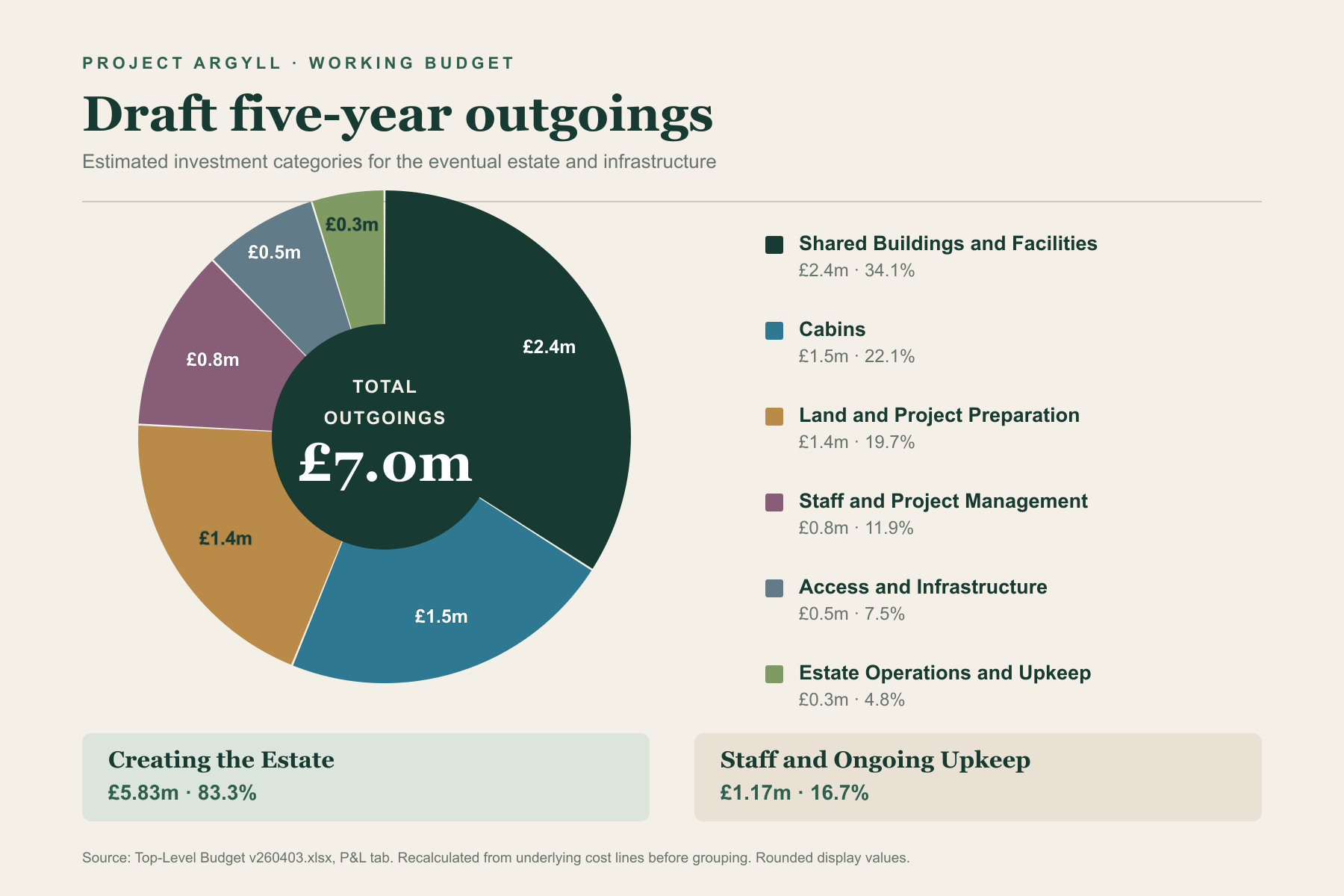
Project Argyll’s current five-year working model sets out an upper-scale budget of approximately £7.0 million. Its purpose is to show prospective Members where commitments are expected to go, expose the assumptions behind the proposition, and give everyone a basis for testing the plan. The figures will change when a specific estate, surveys, planning work, professional quotations, and supplier proposals replace estimates.
We are looking for an estate of approximately 150 to 250 acres. Our intention is to keep around 60% substantially untouched for woodland, water, habitat, and shared enjoyment. The remaining area would accommodate communal buildings, access and energy infrastructure, and professionally mapped individual plots. The shared budget identifies those plots for eventual selection by Members, who are responsible for any eventual building, access, and infrastructure costs on it.
The initial funding model assumes 50 to 70 Members committing £100,000 each, approximately US $125,000, creating a total envelope of £5 million to £7 million. Delivery will be scaled to the commitments actually secured. Project Argyll does not plan to mortgage the land or use debt for the core build. No package should be authorised unless the available capital can complete it, reducing the risk of a critical shortfall leaving an unusable, partly completed estate.
Each category in the chart represents a full working envelope. Initial delivery is intended to be authorised at approximately 75% of the highest estimate, preserving the remaining 25% as planning headroom rather than assuming it will be spent. If land, design, construction, or procurement costs come in below the upper estimates, the Project may therefore cost less than planned or retain greater resilience for later decisions.
Shared Buildings and Facilities, approximately £2.4 million, includes the main lodge, utility and workshop space, pavilion or gazebo, and supporting outbuildings. It also allows for the additional specification and design work required to pursue the sustainability, accessibility, safety, and environmental standards described in our Values and Standards Framework. The Cabins allocation, approximately £1.5 million, provides for the shared three-bedroom cabins that Members can use before or instead of building privately, including their construction and fit-out. When not in use by Members, cabins will be available to the public for short-term lets (e.g. AirBnB), both generating revenue for the ongoing operation of the estate, and introducing new people to the community.
Land and Project Preparation, approximately £1.4 million, covers the estate purchase, architects, surveyors, due diligence, and the professional work needed to turn principles into a site-specific, consentable plan. Staff and Project Management, approximately £0.8 million, supports the directors, project coordination, specialist administration, and operational staff needed to manage acquisition, design, procurement, construction, reporting, and the eventual estate responsibly. Eventual full-time staff anticipated in the budget include a Facilities Manager for the main lodge and cabins, an Estate Manager to maintain the land, access, and internal sites, and a Community Manager to support Members and outreach to local populations and organisations.
Access and Infrastructure, approximately £0.5 million, covers external and internal access works and allowances for the Virtual Power Plant and renewable-energy matrix connecting shared systems and Member homes. This includes planning for generation, storage, balancing, and compatible energy infrastructure. Estate Operations and Upkeep, approximately £0.3 million, provides for maintenance of the main buildings, planned site upgrades, and insurance during the five-year period.
These figures are derived from the Project Argyll Top-Level Budget v260403 working model and its underlying P&L cost lines. This is a working allocation model, not a request for funds or a promise that every line will be spent. Its value is that the principal operational assumptions are visible early, can be challenged by prospective Members and advisers, and can be replaced with evidence as the search advances. Before any commitment is accepted, the selected estate, final scope, safeguards, authorities, and detailed budget will need formal documentation and professional review.